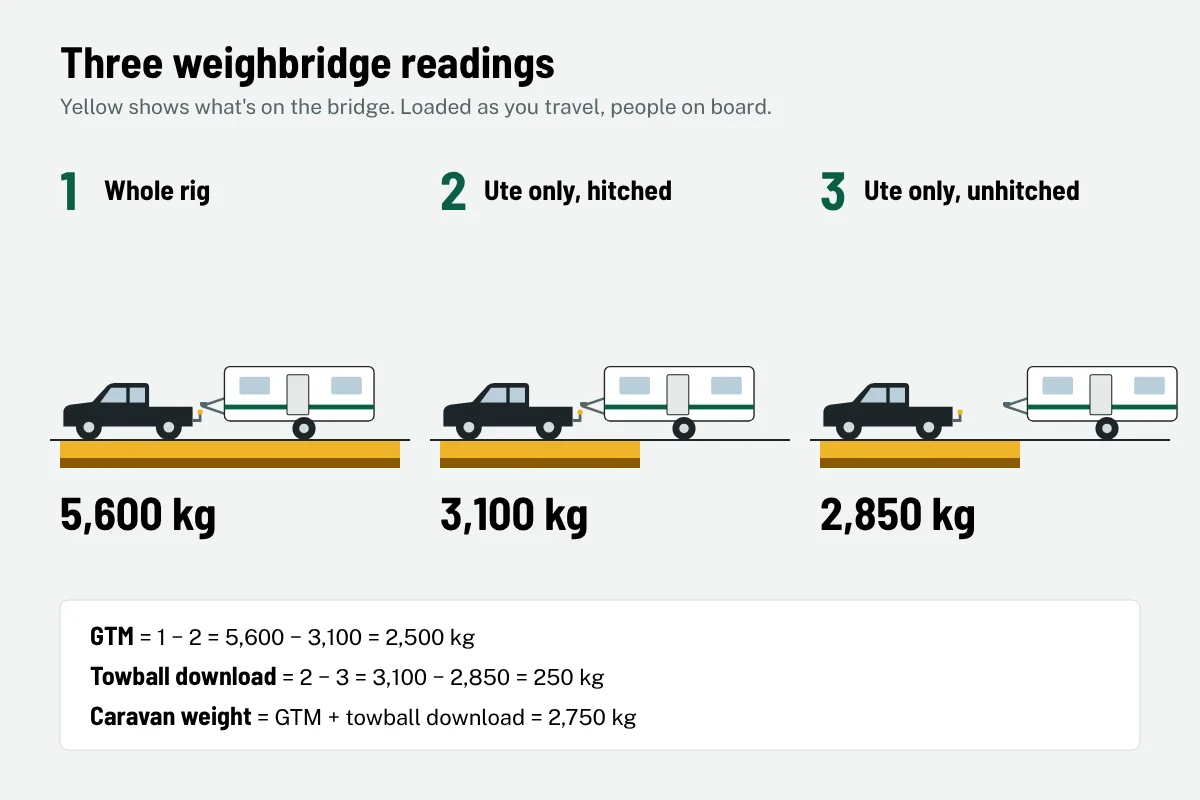
Your plates tell you the limits. Only a scale tells you what you actually weigh. A public weighbridge visit takes about half an hour, often costs little, and answers every question about your setup at once. Here is a method that works on any single-deck weighbridge.
Before you go
- Load up exactly as you’ll travel. Water in the tanks you’ll travel with, full gas bottles, fuel, food, bikes, the lot.
- Bring the people. Passengers count towards GVM, so ride along or note their weights.
- Find a public weighbridge. Councils, grain receival sites, transport depots and some quarries offer public weighing. Search for “public weighbridge” and your town, then call ahead to check hours and whether they can weigh a car and caravan.
- Write down your limits. You’ll want the vehicle’s GVM, GCM, towing capacity and maximum towball download, and the trailer’s ATM and GTM, so you can compare on the spot.
- Ask for a ticket each time. A printed ticket for every reading removes any doubt later.
The three readings
Reading 1: the whole rig
Drive on so every wheel of the vehicle and the trailer is on the bridge. This is your combined weight. Compare it with the vehicle’s GCM.
Reading 2: the vehicle, still hitched
Pull forward until only the vehicle’s wheels are on the bridge, with the trailer still hitched and its wheels on the ground beyond. This is the vehicle carrying the towball download. Compare it with the vehicle’s GVM.
Reading 1 minus reading 2 is the weight on the trailer’s wheels: the trailer’s actual GTM.
Reading 3: the vehicle on its own
Unhitch the trailer away from the bridge and weigh the vehicle alone. Reading 2 minus reading 3 is your towball download.
GTM plus towball download is the trailer’s full weight, its actual ATM. Compare it with the ATM on the trailer’s plate and with the vehicle’s towing capacity.
A worked example
| Reading | Weight |
|---|---|
| 1. Whole rig | 5,600 kg |
| 2. Vehicle only, hitched | 3,100 kg |
| 3. Vehicle only, unhitched | 2,850 kg |
- GTM = 5,600 − 3,100 = 2,500 kg
- Towball download = 3,100 − 2,850 = 250 kg
- Trailer weight = 2,500 + 250 = 2,750 kg
- Towball share = 250 ÷ 2,750 = 9.1%
Then compare: 3,100 kg against the GVM, 5,600 kg against the GCM, 2,750 kg against the towing capacity and the trailer’s ATM, 2,500 kg against the trailer’s GTM, and 250 kg against the vehicle’s maximum towball download.
The weighbridge calculator does the subtraction, and the towing calculator does the comparison.
If you can’t unhitch on the bridge
Some sites are tight. You can still get everything:
- Weigh the vehicle on its own first, before you hitch up, if the trailer is stored somewhere else. That’s reading 3.
- Or weigh the trailer alone, unhitched and resting on its jockey wheel, entirely on the bridge. That reading is its ATM directly. Then hitch up and weigh the trailer’s wheels only to get GTM. ATM minus GTM is the towball download.
A towball weight scale under the jockey wheel or coupling is a handy check between weighbridge visits, especially after you change how the caravan is packed.
Axle weights
Some weighbridges can weigh one axle at a time. If yours can, weigh the vehicle’s front and rear axles separately while hitched. Owner’s manuals often give maximum axle loads, and a heavy towball download can overload the rear axle even when the total is under GVM.
What to do with the results
- All under, with a margin: keep the tickets and re-weigh if you change your setup.
- Close to a limit: look at water, the heaviest gear and anything you carry but don’t use.
- Over a limit: fix it before you travel. Being over GVM, GCM or ATM can create problems with insurance and safety, and it is an offence.
If the GCM is the problem, our guide on why a 3,500 kg towing capacity often isn’t 3,500 kg covers the options.