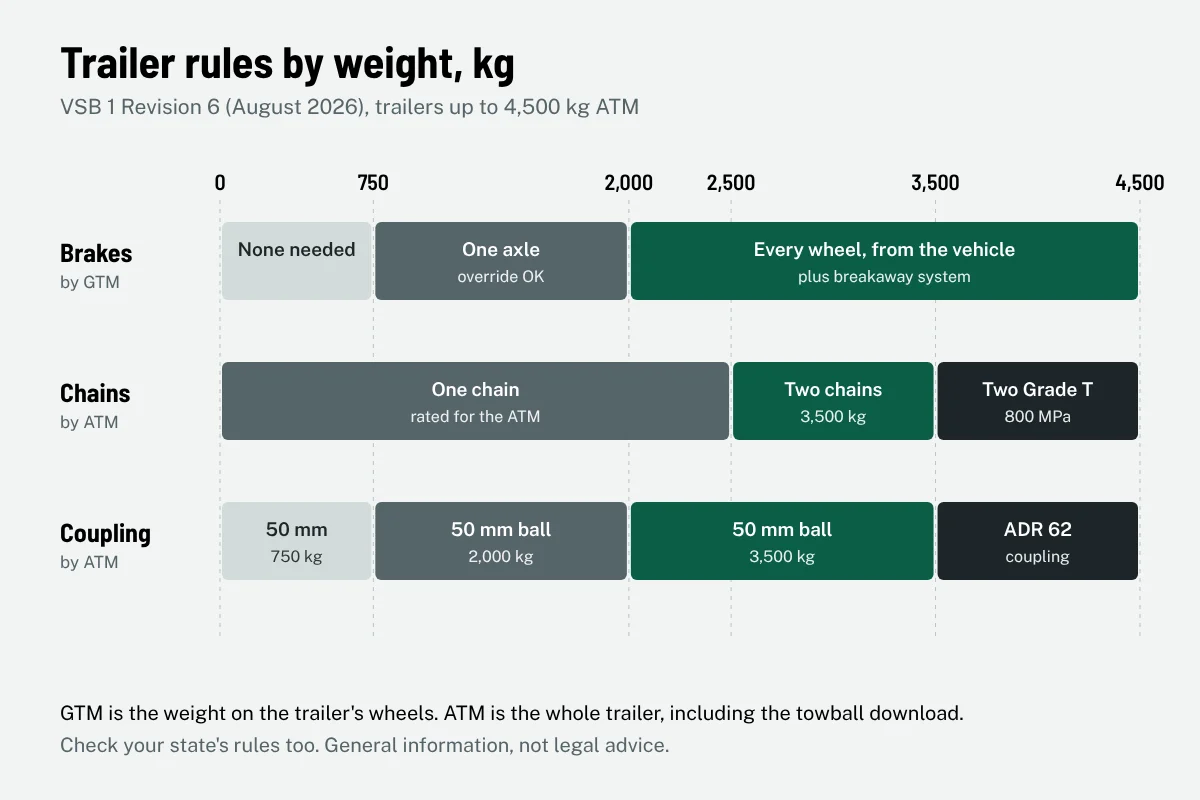
Trailer brake and safety chain rules in Australia are set nationally for trailers up to 4.5 tonnes ATM, in Vehicle Standards Bulletin 1 (VSB 1). The current version is Revision 6, published in August 2026 by the federal Department of Infrastructure. State transport authorities publish their own summaries, and the main thresholds have stayed the same for years.
This guide covers what applies at each weight. For your own trailer, enter its ATM and GTM in the brake and chain requirements checker.
Brakes go by GTM, chains go by ATM
The two sets of rules use different weights, which trips people up.
- Brake rules use GTM, the weight on the trailer’s own wheels when hitched and loaded.
- Safety chain and coupling rules use ATM, the trailer’s total loaded weight including the towball download.
GTM is always lower than ATM, by the amount of the towball download. Both figures are on the trailer’s compliance plate.
Brakes
| GTM | What’s required |
|---|---|
| Up to 750 kg | No brakes required. Any brakes fitted must work. |
| 751 to 2,000 kg | Brakes on at least one axle. Over-run (override) brakes allowed. |
| Over 2,000 kg | Brakes on every wheel, controlled from the tow vehicle. Over-run brakes not allowed. Breakaway system required. |
Over-run brakes work mechanically: when the tow vehicle slows, the trailer pushes against the coupling and a cable applies its brakes. VSB 1 allows them only up to 2,000 kg GTM.
Over 2,000 kg GTM the brakes must be operated by a signal from the tow vehicle. In practice that’s electric or electronic brakes with a brake controller fitted in the vehicle.
Two axles under 750 kg. Earlier versions of the rules allowed unbraked trailers only with a single axle (Tasmania’s guidance counts two axles less than 1 m apart as one). If you have a light tandem trailer near 750 kg, check with your state transport authority.
Breakaway systems
Trailers over 2,000 kg GTM need a breakaway system. If the trailer separates from the vehicle, it must apply the trailer’s brakes immediately and keep them applied for at least 15 minutes. Most systems use a small battery on the trailer and a cable attached to the tow vehicle that triggers the brakes if pulled.
Safety chains
| ATM | Chains | Rating |
|---|---|---|
| Up to 1,000 kg | 1 | 1,000 kg designation to AS 4177.4 |
| Up to 1,600 kg | 1 | 1,600 kg designation |
| Up to 2,500 kg | 1 | 2,500 kg designation |
| 2,501 to 3,500 kg | 2 | 3,500 kg designation |
| 3,501 to 4,500 kg | 2 | Grade T steel, 800 MPa, each with a breaking load above the ATM |
VSB 1 requires safety chains on trailers without breakaway brakes and on all trailers with rigid drawbars, which covers almost every box trailer, boat trailer and caravan.
Good practice from Transport for NSW: keep chains as short as practical, attach them to the tow vehicle, and cross them under the coupling when there are two. Crossed chains cradle the drawbar if the coupling fails.
Western Australia’s guidance adds that shackles joining chains to the towbar must have a breaking load of at least 1.5 times the trailer’s ATM, that stainless steel shackles aren’t suitable, and that chains must be permanently attached at the drawbar end.
Couplings and towballs
- Up to 3,500 kg ATM: a quick-release coupling with positive locking and a second locking device you can see is engaged. 50 mm ball couplings must meet AS 4177.3 and come in 750 kg, 2,000 kg and 3,500 kg ratings.
- Over 3,500 kg ATM: a coupling that complies with ADR 62 (or UN R55). A standard 50 mm ball isn’t rated for this.
The towbar, the towball and the coupling all have their own ratings. The lowest one limits the trailer.
What this means for common trailers
- Small box trailer, 700 kg ATM: no brakes, one 1,000 kg chain, 750 kg coupling.
- Boat trailer, 1,500 kg ATM, 1,380 kg GTM: brakes on at least one axle (override brakes are fine), one 1,600 kg chain, 2,000 kg coupling.
- Family caravan, 2,400 kg ATM, 2,200 kg GTM: electric brakes on every wheel, a breakaway system, one 2,500 kg chain and a 3,500 kg coupling.
- Large caravan, 3,300 kg ATM: the same brakes and breakaway, plus two 3,500 kg chains.
Other rules worth knowing
These come from Transport for NSW and are typical of other states, but check your own state:
- You can tow only one trailer at a time, and no one may ride in a trailer or caravan being towed.
- Learner drivers can’t tow, and NSW P1 drivers may tow only trailers up to 250 kg unloaded.
- Vehicles with a GVM over 4.5 tonnes, and combinations with a GCM over 4.5 tonnes, are limited to 100 km/h in NSW regardless of the posted limit.
- Extra towing mirrors may be needed if the trailer blocks your view behind.
Sources
The thresholds above come from VSB 1 Revision 6 (August 2026), with chain sizes and practice notes from Transport for NSW, the WA Department of Transport and Transport Tasmania. Links are on our sources page.