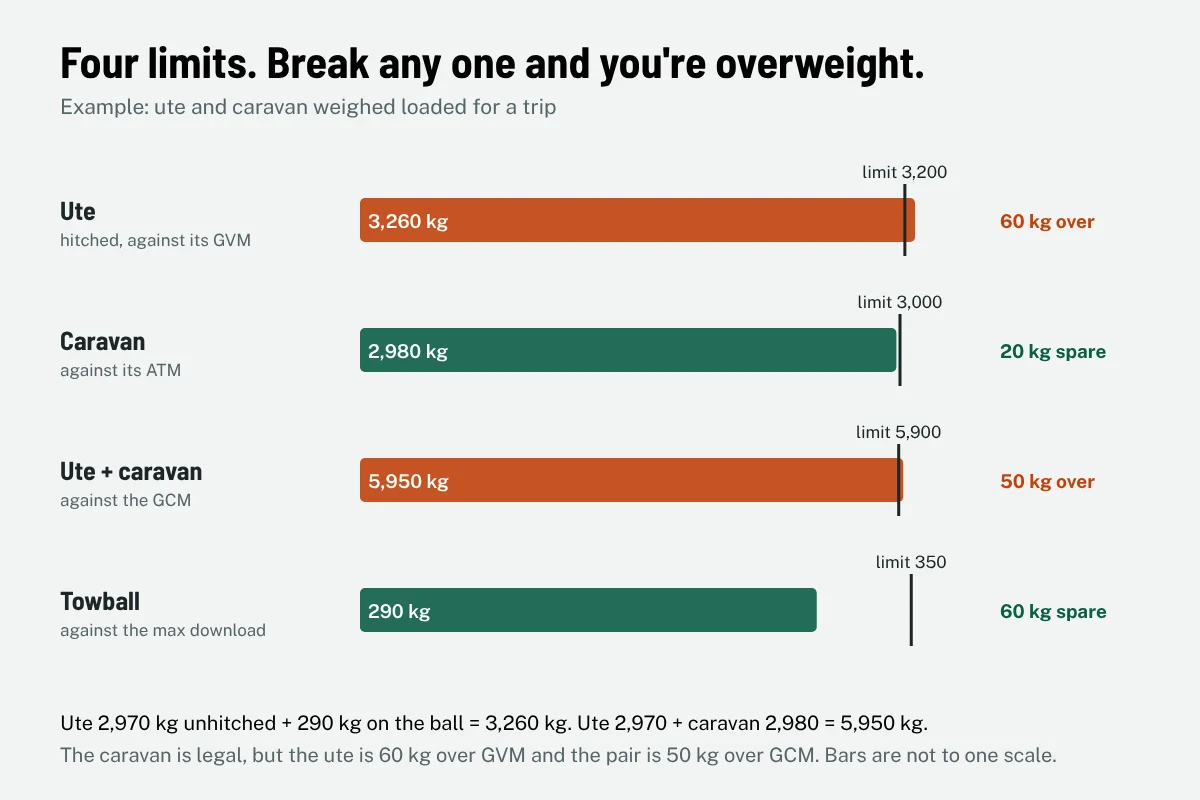
A caravan setup is overweight if it goes over any one of four limits, not just the caravan’s ATM. Transport for NSW puts it plainly: “It is illegal to exceed your vehicle’s GVM, your caravan’s ATM and the combined GCM” (Caravan Safety, Transport for NSW).
The four limits
| Limit | What it covers | Where to find it |
|---|---|---|
| GVM | The tow vehicle, fully loaded, including the towball download | Vehicle compliance plate or owner’s manual |
| ATM | The caravan, fully loaded, as a whole | Caravan’s compliance plate |
| GCM | The vehicle and caravan together | Owner’s manual or manufacturer specs |
| Towing capacity and towball download | The heaviest trailer and the most weight on the ball | Owner’s manual and towbar plate |
The trap is that you can be over one limit while under the others. In the example in the chart, the caravan is 20 kg under its ATM, yet the ute is 60 kg over its GVM and the pair is 50 kg over GCM. That setup is overweight.
What are the fines?
Penalties for overweight light vehicles and trailers are set by each state and territory, and the amounts change, usually every financial year. We only list figures we’ve checked against an official source:
- South Australia: SA Police says “the maximum penalty is $2,500” for failing to comply with light vehicle mass and loading requirements, and that a vehicle “cannot take a load exceeding your vehicle’s GVM” (SA Police fact sheet).
For other states, you’ll see fine amounts quoted on caravan and weighing websites, but we couldn’t match them to an official source, so we haven’t repeated them here. Check your state’s transport department or police for current penalties.
The bigger risks
A fine is often the smallest problem.
- Safety. Transport for NSW warns that an incorrectly loaded caravan “can lead to snaking, swaying or loss of control of your caravan and vehicle.”
- Insurance. Being over a legal limit can give an insurer grounds to reduce or refuse a claim. Read your policy’s wording on overloading and roadworthiness.
- Wear and damage. Running over GVM or ATM loads the brakes, tyres, suspension and chassis beyond what they were rated for.
How to check your setup
- Load up as you’d travel: water, gas, food, gear, passengers, fuel.
- Weigh it. A public weighbridge is the most reliable way. You need three readings: the whole rig, the vehicle alone hitched, and the vehicle unhitched. The weighbridge calculator turns them into each limit.
- Compare with the plates. Use the towing calculator to check every limit at once, and the caravan payload calculator to see what you can still pack.
If you’re over
- Over ATM: take weight out of the caravan. Water is the easiest: every litre is about a kilogram.
- Over GVM: move weight out of the vehicle, or reduce the towball download within the safe range.
- Over GCM: the only fix is less total weight, in the vehicle or the caravan. A GVM upgrade doesn’t help here, because it usually leaves the GCM unchanged.
This is general information, not legal advice. Your state’s rules and your vehicle’s own plates decide what’s legal.