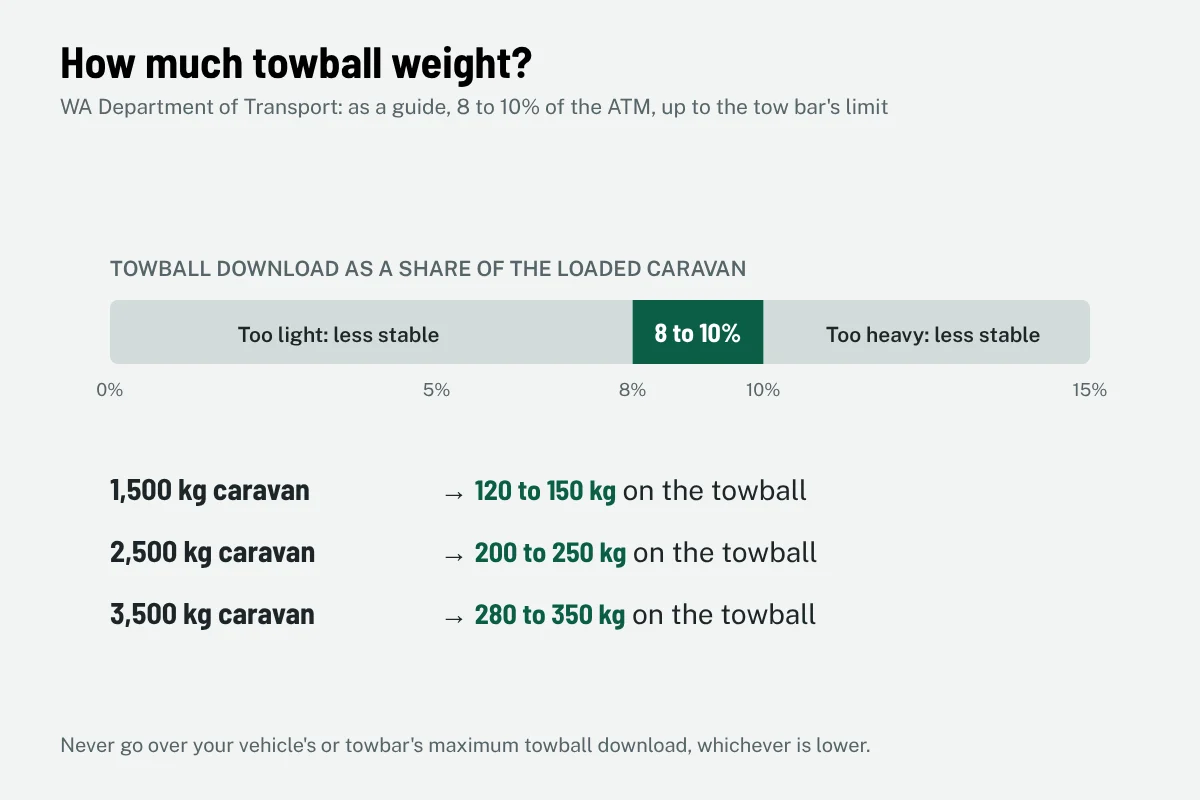
As a guide, a caravan’s towball download should be 8 to 10% of its loaded weight (ATM), and never more than your vehicle’s or towbar’s maximum towball download. That’s the guidance in Western Australia’s official Safe Towing Guide, which also says that going above or below the right download makes the combination less stable.
What 8 to 10% looks like
| Loaded caravan (ATM) | 8% | 10% |
|---|---|---|
| 1,500 kg | 120 kg | 150 kg |
| 2,000 kg | 160 kg | 200 kg |
| 2,500 kg | 200 kg | 250 kg |
| 3,000 kg | 240 kg | 300 kg |
| 3,500 kg | 280 kg | 350 kg |
The percentage is a guide, not a legal number. The legal limits are the maximum towball download for your vehicle and for your towbar, and the guide says the download “must not exceed the maximum load for the vehicle/tow bar design”. If the caravan maker gives its own towball figure, use that.
Your vehicle’s limit comes first
Many utes and 4WDs allow 350 kg on the towball, but not all, and some only with the maker’s own tow kit. For example, Isuzu lists 350 kg for the D-Max and MU-X with a genuine Isuzu UTE tow kit, and BYD lists 250 kg for the 1.5L Shark 6 and 350 kg for the Performance. Check your owner’s manual and the plate on your towbar, and use the lower of the two.
This is where a heavy caravan can catch you out. A 3,500 kg caravan at 10% puts 350 kg on the ball, right at the limit. The same caravan at 12% would put 420 kg on it, which is over. If your vehicle allows 350 kg and your caravan carries 12% of its weight on the ball, the heaviest caravan you can tow is 350 ÷ 0.12 = about 2,917 kg.
Towball download counts against your GVM
The towball download sits on the vehicle, so it counts toward the vehicle’s GVM. The Safe Towing Guide says the “trailer tow hitch download weight must be included as part of the tow vehicle GVM”. A 300 kg download uses 300 kg of your payload, the same as a passenger or a full fridge would.
That’s one reason a vehicle rated to tow 3,500 kg often can’t do it with a family on board. See which utes and 4WDs can really tow 3,500 kg for how much each one has left.
How loading changes it
Where you put things in the caravan moves the towball download a lot. The guide says to place heavy items as close to the trailer axle group and as low as possible, and to check the download again after loading.
- Weight in front of the axle (front boot, gas bottles, a front-mounted tool box) adds to the towball download.
- Weight behind the axle (rear bike rack, spare wheels on the back bar, a rear storage box) takes weight off the towball. Too much of it makes the caravan light on the ball, which reduces stability.
- Water tanks can change it by tens of kilograms depending on where they sit, so check it with the tanks as you’ll travel.
How to check your towball weight
- Weigh it. The guide says the download “can be determined by weighing the trailer at the coupling point”. A towball scale does this directly, or you can work it out at a public weighbridge. The weighbridge guide shows how to turn three readings into your towball download.
- Measure at the right height. Keep the coupling at the same height it sits at when hitched to the loaded vehicle, as the guide says. A level caravan gives the true figure.
- Do the maths. Put your weights into the towball weight calculator to get the percentage and check it against your vehicle and towbar.
A weight distribution hitch isn’t a fix
A weight distribution hitch spreads the towball load across the vehicle’s axles, but the guide says it must not be used “to correct a hitch with excessive download”. If the download is too high, fix the loading or tow a lighter caravan.
50 mm towballs stop at 3,500 kg
The guide notes that the common 50 mm towball isn’t rated beyond 3,500 kg, and trailers from 3,500 to 4,500 kg need a 75 mm ball or another coupling rated to the trailer’s ATM.
This is general information, not legal advice. Your vehicle’s, towbar’s and caravan’s own ratings always come first.