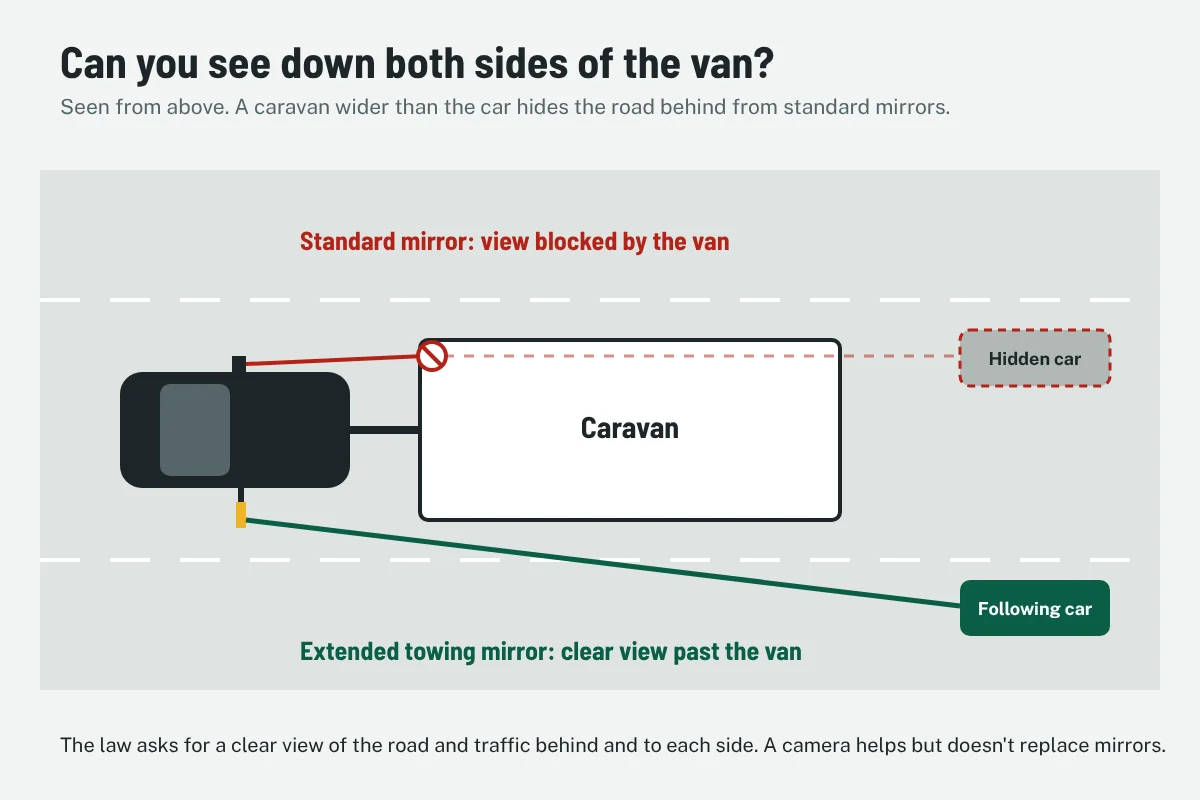
You need towing mirrors whenever the caravan or trailer stops you seeing the road and traffic behind you and to each side. There’s no single “towing mirror law”, and no rule says a van of a certain width always needs them. The test is whether you can see. In practice, almost any caravan wider than the tow vehicle fails that test with standard mirrors.
What the rules actually say
Three things work together.
- The road rules. Under rule 297 of the Australian Road Rules, which every state adopts, a driver must not drive “unless the driver has a clear view of the road, and traffic, ahead, behind and to each side”. You can see it in NSW’s Road Rules 2014, where the maximum penalty is 20 penalty units. A caravan that hides the lane beside and behind it takes that view away.
- The vehicle standards. A rear vision mirror must let the driver, in a normal driving position, clearly see by reflection the road behind and any following or overtaking vehicle. That’s regulation 32 of Tasmania’s Vehicle Standards Regulations 2024, which follows the national light vehicle standards. The same regulations allow extra mirrors to be fitted to a light vehicle.
- State towing advice. Queensland lists “extra mirrors for towing large trailers if required” as towing equipment, and says rear-view cameras “do not replace the need for mirrors” (Queensland Government). NSW says extra mirrors may be needed when towing a large trailer (Transport for NSW).
When you need them
| Your setup | Towing mirrors? |
|---|---|
| Caravan or camper wider than the tow vehicle | Almost always. Standard mirrors look straight into the side of the van. |
| Box trailer or boat narrower than the car, low enough to see past | Usually not, if you can see clearly down both sides. |
| Tall, narrow trailer (horse float, enclosed trailer) | Often. Check the view: height blocks it as much as width. |
| Small car towing a full-size caravan | Yes. The wider the gap between car and van, the more extension you need. |
The quick check: hitch up, sit in the driver’s seat, and look in each side mirror. If you can’t see the lane beside the van and a car sitting 20 metres or so behind it, fit towing mirrors.
A reversing camera doesn’t count
A camera on the back of the caravan helps, especially when reversing, but Queensland says plainly that cameras don’t replace mirrors. The rule is about mirrors you can see by reflection from the driving position.
Clip-on, door-mounted or replacement
Any type is fine legally as long as you can see. In practice:
- Clip-on (strap or clamp) mirrors fit over your existing mirrors. They’re cheap and come off easily, but cheaper ones can vibrate at speed, which blurs the view.
- Door-mounted (arm) mirrors bolt or clamp to the door. Steadier, but they need fitting for your vehicle.
- Replacement extendable mirrors swap out your factory mirrors and slide out when you tow. The tidiest option, and the most expensive.
Take them off, or fold them in, when you’re not towing
A mirror that sticks well out from the vehicle is a hazard to cyclists and pedestrians when you’re not towing. Fold extendable mirrors in, or remove clip-ons, once you unhitch. For vehicles with a GVM over 3.5 tonnes, regulation 32 of Tasmania’s Vehicle Standards Regulations limits mirror projection to 150 mm beyond the vehicle’s width, or up to 230 mm for mirrors that fold back to 150 mm. Check your own state’s rules if your vehicle is in that class.
Towing mirrors go with the rest of the checklist
Mirrors are one part of a legal setup. You also need the right brakes, safety chains and coupling for your trailer’s weight (see the trailer brake and safety chain rules), and a rig within your vehicle’s limits. Check those with the towing calculator.
This is general information, not legal advice. Your state road authority has the final word.