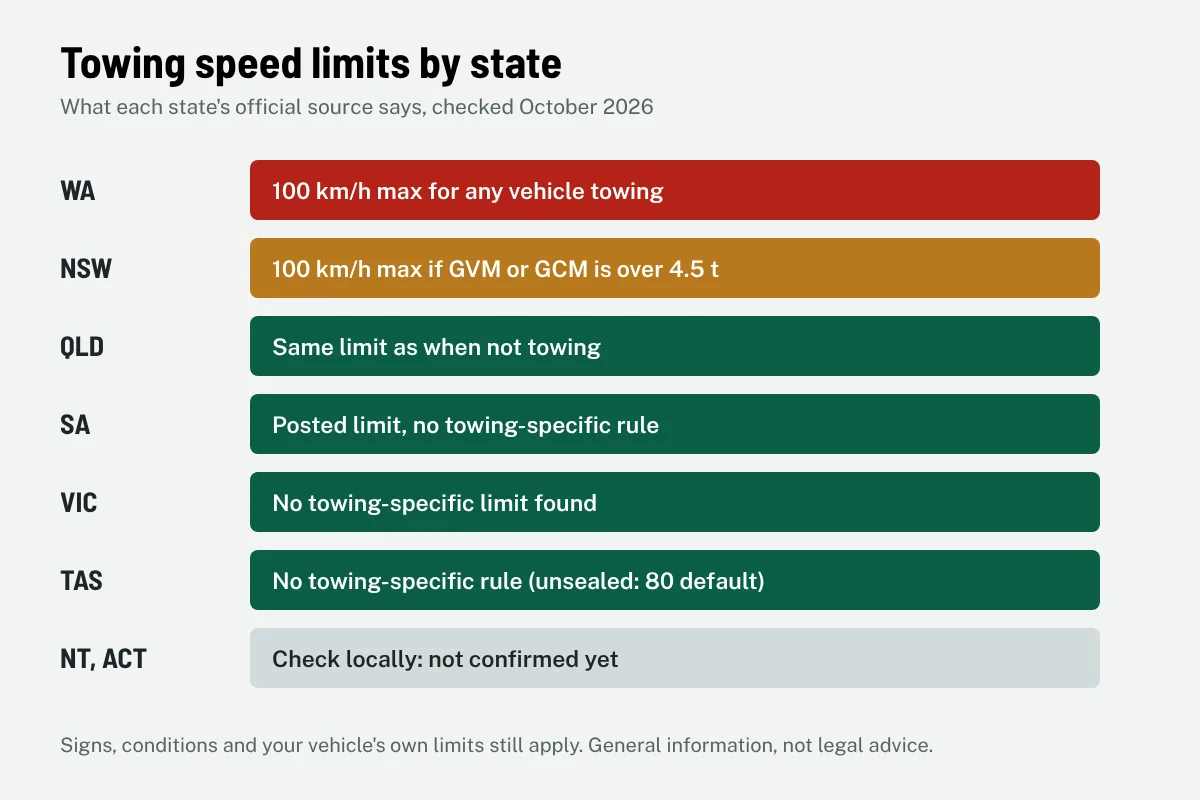
Two states set a speed limit for towing: Western Australia caps any vehicle towing a trailer or caravan at 100 km/h, and NSW caps you at 100 km/h when your vehicle’s GVM or GCM is over 4.5 tonnes, which covers most utes and large 4WDs. In the other states we checked, the official sources don’t set a towing-specific limit, so the posted limit applies. Here’s what each official source says.
The rules by state
| State | Towing speed rule | Official source |
|---|---|---|
| WA | Any vehicle towing a trailer or caravan: 100 km/h maximum | Road Safety Commission, WA |
| NSW | Towing a single trailer with a vehicle GVM over 4.5 t, or a combination GCM over 4.5 t: 100 km/h maximum, whatever the sign says | Transport for NSW |
| QLD | Same speed limit as a vehicle that isn’t towing | TMR Safe towing guide (PDF) |
| SA | Obey the speed limit for the road; no towing-specific limit given | The Driver’s Handbook: towing |
| VIC | No towing-specific limit on the official page we checked; heavy vehicles are capped at 100 km/h | Transport Victoria: heavy vehicle road rules |
| TAS | No towing-specific rule in the Road Rules; default 100 km/h on sealed roads and 80 km/h on unsealed roads where no sign applies | Road Rules 2019, rules 21 and 25 |
| NT | Not confirmed on an official page yet | Check with the NT Motor Vehicle Registry |
| ACT | Not confirmed on an official page yet | Check with Access Canberra |
“Not confirmed” means we haven’t yet found an official NT or ACT page that addresses towing speed. We’ll add them once we do, rather than repeat what other websites say.
Why the NSW rule catches most ute and 4WD owners
The NSW rule turns on GCM, and GCM is a rating set by the vehicle maker, not what your setup weighs on the day. Most utes and large 4WDs have a GCM well over 4.5 tonnes. For example, the Ford Ranger is rated at 6,200 to 6,400 kg and the Isuzu D-Max at 5,850 to 6,000 kg. So in NSW, towing a caravan, boat or camper trailer with one of these means 100 km/h is your limit, even on a road signed 110.
If you’re not sure how the rule applies to your vehicle, check your GCM on the compliance plate or in the owner’s manual, or ask Transport for NSW.
WA: 100 km/h for everyone towing
WA’s rule doesn’t depend on weight. A small car towing a box trailer is capped at 100 km/h just like a ute towing a caravan. The same WA page also says you must stay at least 60 metres behind a heavy vehicle or another vehicle that’s towing, unless you’re overtaking.
Tasmania: unsealed roads default to 80 km/h
Tasmania’s Road Rules set a default limit of 80 km/h on unsealed roads where no sign applies, for every driver. Its 100 km/h cap on roads signed above 100 applies to buses with a GVM over 5 tonnes and other vehicles with a GVM over 12 tonnes, not to cars towing.
The limit isn’t the only thing that matters
- Your vehicle’s own advice. Some owner’s manuals give a lower recommended speed when towing. Check yours.
- Conditions. NSW says to drive to the road, traffic and weather conditions as well as the limit. A heavy van in a crosswind or on a long descent may need much less than 100 km/h.
- Weights. A rig that’s over its GVM, GCM or towing capacity is illegal at any speed. The towing calculator checks all four limits at once.
- Interstate trips. If your summer trip crosses a border, the rules change with it. A ute and van doing 110 in Victoria needs to drop to 100 entering NSW.
This is general information, not legal advice. Road rules change, so check the official source for each state you’ll drive in before you go.